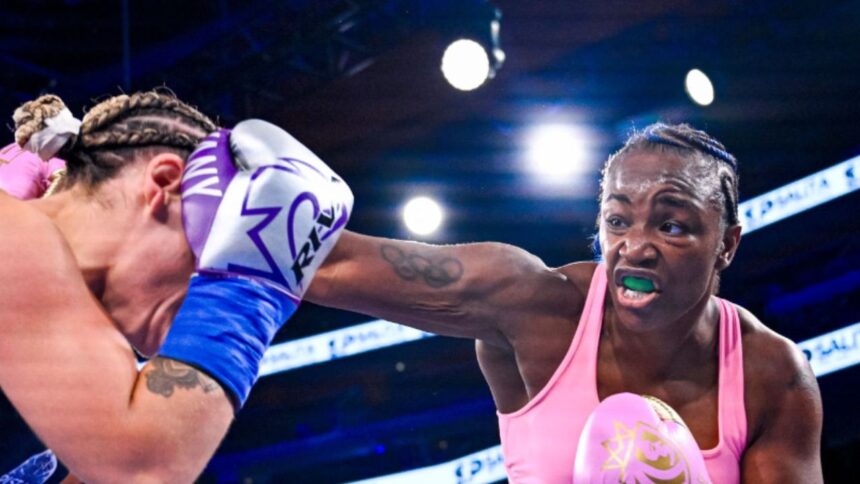
Exclusive: USA Boxing Asst. Coach Calls for Amateur Boxers to Emulate Claressa Shields Instead of Chasing Quick Cash
In a world where boxing seems increasingly driven by money and fame, the once-proud tradition of amateurism is rapidly diminishing. Each year, more young fighters leap into the professional arena before even turning 20, spurred by the allure of financial gain and fame. Recently, 15-year-old Mexican boxer Rianna Doforo made headlines for her pro debut against the seasoned Milagros Hernandez Gonzalez. In stark contrast, U.S. regulations typically prevent such early transitions. Despite this, American amateurs often race to turn professional as soon as they’re eligible. USA Boxing Assistant Coach Christine Lopez has issued a passionate plea for these athletes to follow the example set by the GWOAT, Claressa Shields, and commit longer to the Olympic team.
A Changing Landscape in Olympic Boxing
In the heyday of boxing, teams from the United States and Great Britain proudly sent robust contingents of ten to twelve amateur boxers to the Olympics. Fast forward to the 2024 Paris Olympics, and the picture is markedly different. The U.S. team qualified only eight boxers, with Omari Jones securing a bronze medal. Great Britain fared even worse, sending just six boxers, among whom Lewis Richardson achieved a bronze.
Lopez, in an exclusive interview with EssentiallySports, reflected on this troubling trend: “It’s been that way,” she remarked. She pointed out that both the U.S. and UK teams frequently see new sets of boxers each quarter. Once these boxers turn professional, they require extensive acclimatization, a process that hampers their development and performance.
Lopez simply remarked, “It’s been that way.” She explained that the UK and the US get a new set of boxers every quarter, and after those boxers turn professional, they “have to get them accustomed to everything.”
Lopez said, “I think people do see the bright lights. They see the money and they don’t see deeper than that or beyond that. So, it’s unfortunate.” Having to part with brilliant boxers before they achieve their full potential, a disheartened Lopez added, “I would like to see some of our team stay.” Because by the time the Los Angeles Olympics comes around in 2028, “they are gonna have perfected their craft”, Lopez told EssentiallySports.
Olympic Restrictions and Professional Ambitions
The unique restrictions of the U.S. and British boxing teams, which prohibit professional boxers from competing in the Olympics, have been a significant factor in this evolving landscape. This rule, which was temporarily relaxed during the 2020 Tokyo Olympics due to the pandemic, has since reverted to its original form.
Lopez voiced her concerns about the shift in focus from Olympic glory to professional earnings: “I think people do see the bright lights. They see the money and they don’t see deeper than that or beyond that. So, it’s unfortunate.” The coach expressed a deep sense of regret over losing promising talent to the professional circuit before they have fully realized their potential. She hopes that by the time the Los Angeles Olympics roll around in 2028, these athletes will have honed their skills to perfection.
“Claressa [Shields] did it [for] two golds. She could have gone for a third, I am sure, cuz she was so young”, Lopez said. Nonetheless, she acknowledged the effects of amateurs turning pro early, stating, “It has changed because people are going pro.”
View this post on Instagram
Claressa Shields: A Beacon of Olympic Excellence
Lopez highlighted the remarkable achievements of Claressa Shields as a model for current and future amateurs. Shields, the only female boxer to win consecutive Olympic gold medals, exemplifies the success that can be achieved through dedication to amateur boxing. Her journey began with a historic gold medal at the 2012 London Olympics, a milestone marking the debut of women’s boxing. Despite a setback at the 2012 Women’s World Championships, Shields used the loss as motivation, guided by the encouragement of her childhood trainer.
By the time the 2016 Rio Olympics arrived, Shields was a formidable competitor, earning her second gold medal with a combination of confidence and skill. Her journey is a testament to how perseverance and commitment to the amateur ranks can lead to extraordinary achievements and set the stage for future generations.
The Road Ahead for USA Boxing
The current state of the U.S. Olympic boxing team suggests that a return to former dominance will require a renewed commitment from amateur athletes. As the sport evolves, the challenge will be to balance the lure of professional success with the value of Olympic competition. The question remains: will the future of U.S. boxing be shaped by quick transitions or by a dedication to long-term development?
Editor’s Note:
The shifting dynamics of amateur and professional boxing underscore the need for a thoughtful approach to athlete development. As boxing evolves, ensuring that young talents have the opportunity to maximize their potential within the Olympic framework is crucial for the sport’s future success.