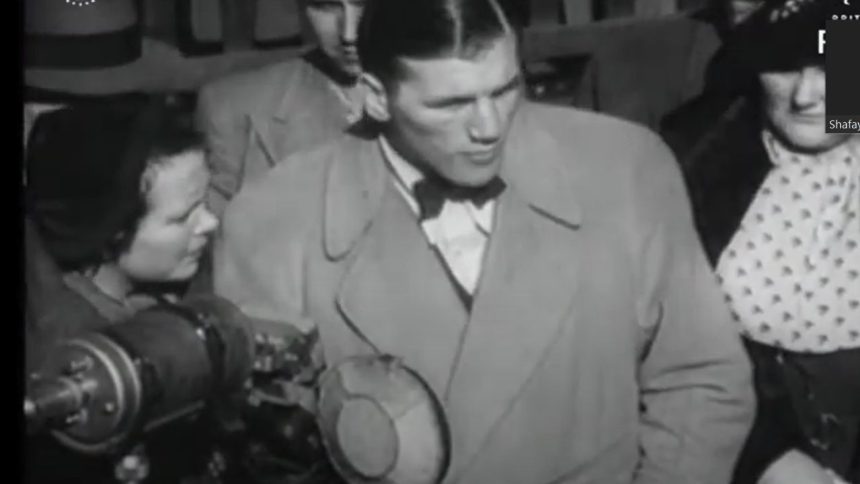
Biography of Tommy Farr

| Born | Thomas George Farr |
|---|---|
| 12 March 1913 | |
| Clydach Vale, Rhondda, Wales | |
| Died | 1 March 1986 (aged 72) |
| Nationality | Welsh |
| Statistics | |
| Weight(s) | Heavyweight |
| Stance | Orthodox |
| Boxing record | |
| Total fights | 137 |
| Wins | 84 |
| Wins by KO | 24 |
| Losses | 34 |
| Draws | 17 |
| No contests | 2 |
Early Life and Career
Born on March 12, 1913, in Clydach Vale, Rhondda, Wales, as Thomas George Farr, Tommy Farr rose to become one of the most renowned boxers in British history. Initially competing in the light heavyweight division, Farr claimed the Welsh championship before transitioning to the heavyweight category in 1936.
Farr’s early boxing career was characterized by a mix of victories and losses, with notable wins over Tommy Loughran and former champion Max Baer in 1936 and 1937, respectively. These victories paved the way for Farr’s shot at the world heavyweight title against Joe Louis.
Thomas George Farr, born on March 12, 1913, in Clydach Vale, Rhondda, was a Welsh boxer renowned as “The Tonypandy Terror.” Before 1936, Farr competed in the light heavyweight division, achieving the title of Welsh champion. His ascent to prominence culminated on March 15, 1937, when he clinched the British and Empire heavyweight championship.
Farr’s legacy as one of the greatest British heavyweight fighters was solidified with his induction into the Welsh Sports Hall of Fame in 1997. However, it was his unforgettable 1937 world title challenge against Joe Louis that etched his name in boxing history. The bout, spanning the full 15 rounds, showcased Farr’s tenacity, as he repeatedly troubled Louis, earning the respect of the audience.
Despite Farr’s impressive performance, the final decision favored Louis in a contentious unanimous verdict. Referee and judges awarded the fight overwhelmingly to Louis, inciting widespread disapproval from spectators. Despite the controversy, Farr’s display of skill and resilience earned him recognition as The Ring magazine Fighter of the Year for 1937.
Legendary World Title Challenge
On August 30, 1937, Farr faced off against Joe Louis, the reigning heavyweight champion, at Yankee Stadium, New York City. Despite Louis’s dominance in the ring leading up to the fight, Farr proved to be a formidable opponent. The bout, which lasted 15 rounds, saw Farr delivering powerful blows to Louis, earning respect from fans and critics alike.
However, the decision ultimately went in Louis’s favor in a controversial points decision. Referee Arthur Donovan’s gesture of raising Farr’s glove in victory stirred controversy, with many questioning the judges’ scoring. Despite the loss, Farr’s performance solidified his reputation as a skilled and resilient fighter.
On August 30, 1937, at Yankee Stadium, New York City, Tommy Farr faced off against world heavyweight champion Joe Louis in what would become one of the most memorable bouts in boxing history. Despite Louis’s dominant record, having knocked out eight of his previous nine opponents and subsequently knocking out his next seven, Farr’s performance proved to be formidable.
In front of a crowd of 50,000 spectators, Farr displayed remarkable skill and resilience, landing significant blows that left Louis visibly hurt. However, the fight ended controversially, with Louis ultimately declared the winner by a wide points decision after 15 rounds. The announcement of Louis’s victory was met with boos from the disappointed audience.
Referee Arthur Donovan, Sr. inadvertently added to the controversy by seemingly raising Farr’s glove in victory, sparking debate about the validity of the decision. Seven years later, Donovan publicly apologized for the misunderstanding, clarifying that he had intended to congratulate Farr for his impressive performance.
Despite differing accounts of the fight’s outcome, with some arguing that Farr deserved the win, the controversy persisted for years. Tommy Farr himself reflected on the intensity of the battle, recalling how his nose still bled whenever he discussed the fight. Even in The Encyclopedia of Boxing, opinions remained divided, with some suggesting that Louis’s victory was narrow, while others acknowledged his strong comeback during the match.
Later Career and Legacy

Following his memorable bout with Louis, Farr faced several challenges in the ring, including defeats against James J. Braddock and Max Baer. Despite these setbacks, Farr continued to compete, enjoying a string of victories upon returning to the UK in 1939.
However, personal tragedies and financial difficulties plagued Farr’s later years, leading to bankruptcy and his eventual return to boxing at the age of 36. Despite his hardships, Farr’s determination and resilience remained unwavering.
In 1940, Farr retired from professional boxing, later running a pub in Brighton, Sussex. He passed away on March 1, 1986, at the age of 72, leaving behind a legacy as one of Britain’s greatest heavyweight fighters.
In Popular Culture
Farr’s remarkable life story inspired the creation of “Contender,” a musical that premiered in 2007. The production, composed by Mal Pope, explores Farr’s career and highlights his integrity in refusing to cooperate with fight-fixing mobsters and bookmakers, cementing his place in boxing history as a true champion inside and outside the ring.