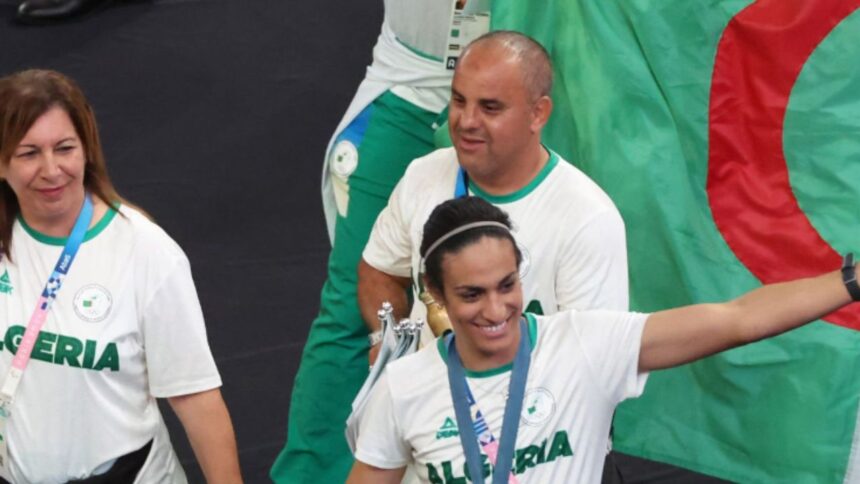
Imane Khelif’s Triumph and the End of Controversy: Testosterone Tests and Gender Debate Resolved
The intense scrutiny surrounding Algerian boxer Imane Khelif’s gender identity reached a climax with her recent Olympic victory, a journey marked by fierce debates and public controversies. The gold medal she clinched in Paris was overshadowed by allegations and doubts about her eligibility, but recent revelations and tests are set to put these controversies to rest.
The Fallout of a Controversial Test
Khelif’s road to Olympic glory was marred by a contentious gender eligibility test conducted by the International Boxing Association (IBA). The IBA’s decision to bar her from the 2023 World Championships, based on claims of an XY chromosomal pairing, sparked a media frenzy and heated debates across the sports world. Critics argued that these findings questioned her legitimacy to compete in the women’s category.
However, the latest disclosure by Khelif’s team offers a definitive counterpoint to these accusations. Her trainer, George Cazorla, revealed to French magazine Le Point that following her disqualification, a renowned endocrinologist from the Parisian University Hospital, Kremlin-Bicêtre, confirmed Khelif’s gender despite the chromosomal anomaly. “The endocrinologist stated unequivocally that Imane is a woman, despite her karyotype and testosterone levels,” Cazorla explained. This assertion challenges the previous claims and provides a scientific basis for her participation in women’s events.
“He confirmed that Imane is indeed a woman, despite her karyotype and her testosterone level. He said: ‘There is a problem with her hormones, with her chromosomes, but she is a woman,’” Cazorla mentioned before sharing the recent findings.
The Role of Testosterone Regulation
After the disqualification, Khelif’s team took proactive steps to address the concerns raised about her testosterone levels. Collaborating with a specialist in Algeria, they worked to regulate her hormone levels, which are now within the female norm. “Tests clearly show that her muscular and other physical qualities have been diminishing since the intervention,” Cazorla added, reinforcing Khelif’s compliance with the standards expected of female athletes.
“We then worked with a doctor based in Algeria to monitor and regulate Imane’s testosterone level, which is currently within the female norm. Tests clearly show that all her muscular and other qualities have been diminishing since then,” Cazorla added.
Imane Khelif said, “I am a woman like any other. I was born a woman, I lived a woman, I competed as a woman, there’s no doubt about that.” She also addressed the accusations and false claims against her.
Names such as Elon Musk, and author JK Rowling spoke out against Khelif, with swimmer Riley Gaines posting on X, “men don’t belong in women’s sports.”
“The Algerian boxer did a test that came back stating she had the XY chromosome, which is biologically a male; that’s not true; that test was not done; the IBA has never said that test was done,” he said.
“No one ever stated that it was a genetic test [for] chromosome XY,” Chael Sonnen argued.
The Paris Olympics Controversy
Khelif’s Olympic journey was not without its share of controversies. Her match against Italy’s Angela Carini, which ended in just 46 seconds after Carini withdrew, fueled speculation about Khelif’s eligibility. The abrupt end of the bout, coupled with Carini’s tearful exit, intensified doubts about Khelif’s fairness in competition. The situation escalated as Khelif faced criticism from several prominent figures, including Elon Musk and author J.K. Rowling, who voiced their concerns on social media.
Despite this, Khelif’s resilience shone through as she continued her campaign, defeating Hungary’s Luca Anna Hamori and Thailand’s Janjaem Suwannapheng before ultimately securing the gold medal against Liu Yang. Her performance in these matches was a powerful rebuttal to the accusations, demonstrating her skill and determination.
Public Support and Advocacy
The controversy surrounding Khelif saw her receiving both support and criticism from the public and celebrities alike. While some, like swimmer Riley Gaines, criticized Khelif’s participation, others, including AC Milan’s Ismael Bennacer and former UFC fighter Chael Sonnen, defended her. Sonnen, in particular, used his platform to address the misunderstandings surrounding the case, emphasizing that the IBA’s testing protocols were flawed and lacked transparency.
Sonnen argued that the IBA’s claims of an XY chromosomal test were unfounded, as no such test had been officially documented. He urged for empathy towards Khelif and highlighted the broader implications of the controversy on athlete inclusion and fairness.
Editor’s Perspective
Imane Khelif’s journey through this controversy underscores the complexity of gender identity in sports and the need for clarity and fairness in testing protocols. Her recent triumph in the Olympics, coupled with the revelations about her testosterone levels, not only validates her achievements but also highlights the importance of thorough and transparent procedures in maintaining the integrity of competitive sports. The resolution of this controversy should pave the way for a more equitable approach to gender eligibility in athletics.