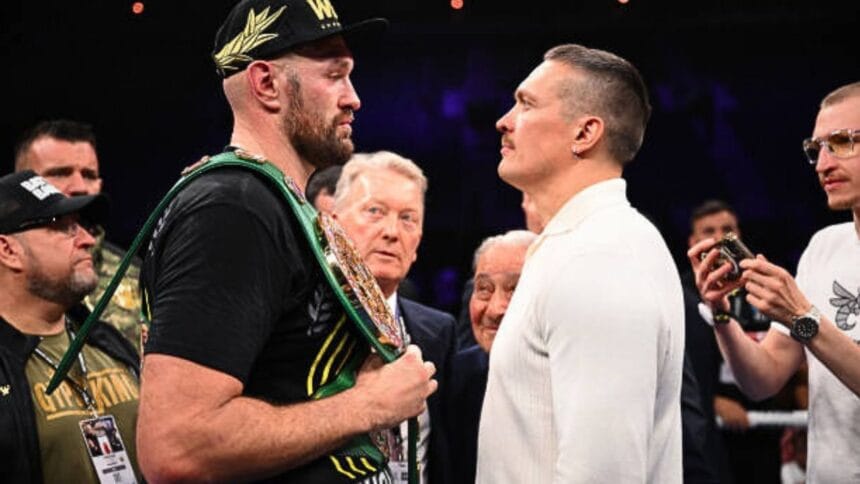
However we’ve all properly weeped over how much time it’s taken to arrive while accusing the numerous endorsing bodies, the advertisers, the telecasters and, surprisingly, the different contenders required for the postponement, truly challenges as ginormous as Tyson Fury Oleksandr Usyk have forever been something of a unique case.
The current politicking and tangled title framework ought to be considered incompletely capable, in any case. In basically every other period (beside this four-belt time), the boss would battle their nearest rival as per usual. Thusly, there basically wasn’t sufficient opportunity – like, say, 25 years – for the craving to fabricate like it has for this one. In this manner, in the event that we’re to draw a positive from that quarter of a century pause, it’s that we wouldn’t currently be close to as energized in the event that we hadn’t been compelled to get through it.
However, there are different battles to which we can analyze Fury Usyk, regarding interest.
At the point when Jack Johnson was the world heavyweight champion, such was the behavior that most people find acceptable in 1910 there was an all-powerful noise for him to lose his title to a white man. To such an extent that previous boss – the unbeaten however maturing James J Jeffries – was pulled out of a six-year retirement gauging a detailed 300lbs with a $10,000 marking on reward and the commitment of a strong piece of the $101,000 handbag.
Rumors have spread far and wide suggesting that Johnson at first consented to toss the battle for an attractive aggregate however when the area was changed from San Francisco to Reno, and subsequently the first agreement was torn up, the boss had a shift in perspective and proclaimed it would be an instance of best man wins.
Show advertiser Tex Rickard – who hailed Johnson-Jeffries as the ‘Battle of the 100 years’ – was likewise bending over as the ref and a few eyewitnesses from the time detailed that, secretly, Jeffries knew the main way he could win was assuming the fix was in.
In any case, general society was contributed to outrageous levels and a field was built explicitly for the battle, which occurred on July 4, 1910. Jeffries, despite the fact that rusty and desire, opened as a 10/7 number one and practically all the 15,670 in participation anticipated that he should win. In Chicago a further 10,000 individuals, who like those in the field were solely white, assembled external the Tribune working to stand by listening to a guy with a bull horn give refreshes on the activity. In New York, 30,000 were in Times Square to keep their eyes on another gadget that gave mechanized refreshes.
Heavyweight History Dictates That Fury-Usyk Won’t Live Up To The Hype https://t.co/Vus98XoFiB
— BoxingScene.com (@boxingscene) May 16, 2024
The actual battle was an uneven and lukewarm issue. In the fifteenth round, Johnson decked a swelled and ridiculous Jeffries who obediently though irredeemably scrambled to his feet. Count beaten however Johnson a long way from, Jeffries then ended up punched out of the ring, helped back in by correspondents, then at last stunned for the third and last time. The clubbing was everywhere, so too was the thought of Johnson-Jeffries truly being smart.
After 28 years, with The Second Great War edging nearer and nearer, America was sharp for new heavyweight lord Joe Louis, just the second African American after Johnson to wear the crown, to this time beat the white man.
Two years prior, Germany’s previous world winner Max Schmeling had shocked Louis, who was considered near unsurpassable at that point, when he halted the “Earthy colored Plane” in a non-title battle in 12 rounds.
By June 1938, Louis as opposed to Schmeling II was the greatest occasion in sport. Schmeling was the accidental mascot of Adolf Hitler’s Germany with Louis, who had beaten Jimmy Braddock to come out on top for the championship, the man to stop the most extravagant award in sport winding its direction towards the Nazis.
Organized in Yankee Arena, New York, before 72,000 fans, Louis opened as a 3/1 number one in spite of the consistent beatdown he’d persevered in the principal battle. In contrast to Jeffries, notwithstanding, Louis demonstrated the bookmakers right with an appearance that stays one of his generally splendid. What’s more, fierce.
Louis dropped Schmeling multiple times in the initial round, each time from nauseating right hands, and it’s just as simple as that. However Louis’ electric execution wowed those in participation, a cutthroat challenge it was not.
“Taking everything into account,” revealed the New York Times, “the speculation seats, which raced to $30 each, was an unfortunate one.”
However incalculable important heavyweight title challenges occurred somewhere in the range of 1938 and 1971 they were, as portrayed already, to a great extent happening naturally and thusly not at all like the world-halting occasion that occurred when Joe Frazier and Muhammad Ali crashed interestingly.
The purposes behind the tremendous allure of Frazier-Ali don’t require retelling here. However the subplots were copious – especially offered the contenders’ clashing perspectives on the Vietnam War – what the world needed and expected was, just, a decent battle.
Barely any games, both previously and since, have matched Frazier-Ali for overall interest. Fifty nations bought telecom freedoms and discourse for the challenge extended to 12 distinct dialects. It has been assessed that upwards of 300 million individuals watched.
It’s dubious that any of them could guarantee not to have been engaged and this stays the highest quality level in heavyweight super battles since one of only a handful of exceptional genuinely followed through on the promotion.
Ali bossed the initial rounds, Frazier came serious areas of strength for on the fourth and it seemed as though anybody’s battle until the eleventh, when “Smokin” Joe had his adversary in a wide difficult situation. There was still time for a retaliate of sorts before the last round when Frazier opened up that left snare and scored one of the most well known of all knockdowns.
Every way under the sun, it was the battle of the 100 years.
Ali and Frazier had both since a long time ago resigned when Mike Tyson showed up in the following ten years. Furthermore, Tyson accompanied such astounding power, no one could hinder him. By 1988, Tyson had tidied up the wreck made by the embracement of various authorizing bodies and held the WBC, WBA and IBF titles. Just a single feasible challenger remained.
In 1985 Michael Spinks turned into the primary ruling light-heavyweight champion to win a rendition of the heavyweight title when, in a colossal bombshell, he took the IBF title from the incomparable Larry Holmes on a nearby 15-round choice then, at that point, rehashed the accomplishment, but combatively, the next year.
Holmes was viewed as the one who beat the man and Spinks, consequently, turned into that man. A man that Tyson, in spite of holding every one of the belts, was at this point to turn into. In 1987 Spinks surrendered the IBF lash to seek after a cash turning session with Gerry Cooney and the manner in which he won that battle – Spinks drubbed Cooney in five – persuaded cynics regarding his heavyweight capacities.
The craving for Tyson-Spinks was colossal. However relatively few were picking Spinks to win there was no question that he was viewed as the most imposing adversary of Tyson’s vocation. What’s more, at that phase of it, most fans were enthusiastic just to see “Iron” Mike in a serious battle.
Charged ‘For the last time’, Tyson-Spinks occurred at Atlantic City’s Show Lobby on June 27, 1988. Each had a real case to the heavyweight privileged position and a rat horde of 21,785 were there to observer with a lot more close by to absorb the environment. At that point, Atlantic City could brag $215 million in betting income on an end of the week yet, with Tyson and Spinks around, that figure rose to $344 million.
Any individual who put cash on Spinks, nonetheless, would probably have lamented their choice when they spotted him stroll to the ring, crossing his chest and looking noticeably uncomfortable. Tyson, who we currently know was at his outright pinnacle, tore through his enemy in 91 seconds. Spinks resigned one month after the fact and Tyson, destined to be consumed by the overabundances of superstardom, never entirely as great again.
The Nineties followed and however there were a lot of superb matchups, the division coming up short on characterizing battle. Evander Holyfield, Riddick Bowe, Michael Moorer and, surprisingly, a comebacking Tyson all played with the main spot, however not a single one of them figured out how to engage the enduring number two, Lennox Lewis.
That changed in Walk 1999 when Holyfield and Lewis met up in Madison Square Nursery. Indeed, you know the rest. A dull battle and a wailing distraught draw left the large numbers who paid great cash to watch it feel determinedly bamboozled.
We’ve had large battles in the division from that point forward, obviously. The greatest, maybe, was when Wladimir Klitschko went head to head with David Haye in 2011. With three belts on the line (WBO, IBF and WBA) it was the nearest to ‘undisputed’ we’d had for a long time be that as it may, once more, the actual battle was forgettable as Klitschko utilized his better size and strength than supervisor a large portion of the 12 rounds.
Anthony Joshua’s amazingly exhilarating success over Klitschko in 2017 avoided the pattern at the same time, with the Ukrainian idle in advance and Deontay More stunning and Tyson Fury approaching behind the scenes, it didn’t feel like the all-vanquishing challenge that Fury Usyk is considered to be.
Fortunately we’re finally going to see that all-vanquishing challenge yet the terrible, assuming heavyweight history is anything to go by, its probability satisfying the expectations is thin.