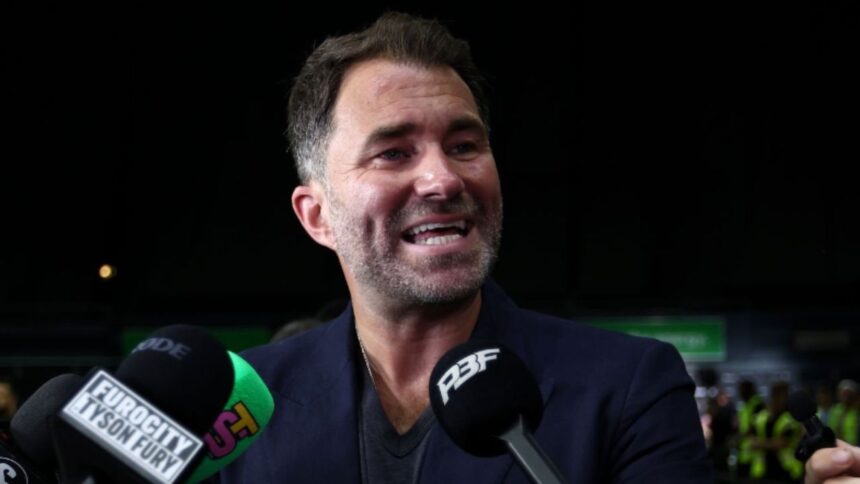
Eddie Hearn Criticizes Terence Crawford’s Career: “You Don’t Just Become a Pay-Per-View Star”
In the world of boxing, becoming a Pay-Per-View (PPV) star is no easy feat. It’s a journey that requires careful planning, strategic promotion, and a strong connection with fans. Yet, despite Terence Crawford’s undeniable talent and an undefeated record of 41-0, his career trajectory has sparked debate. A key voice in this discussion is British boxing promoter Eddie Hearn, who recently weighed in on why Crawford, despite his successes, hasn’t reached the PPV heights many expected.
Crawford’s recent fight against Errol Spence Jr. sold 700,000 PPVs—a respectable number by any measure. However, when the Omaha-born fighter returned to the ring this year to challenge at 154 pounds, his PPV sales reportedly plummeted to just 100,000 in the U.S. The stark contrast in these figures has led to questions about what went wrong, and Hearn believes the answer lies in Crawford’s early career marketing.
Speaking with Andre Ward on the All the Smoke Fight podcast, Hearn, 45, shared his thoughts on how fighters like Crawford, who were groomed under Bob Arum’s Top Rank label, have struggled to maintain consistent PPV success. Hearn pointed out that Crawford’s situation is a prime example of how a fighter’s potential can be undermined by poor promotional strategies.
Hearn said, “You don’t just become a pay-per-view star. You have to be built from an early part of your career if you want to do the big numbers. And I just feel like Terence Crawford wasn’t built properly coming through.”
Crawford spent the majority of his career under Top Rank, only to have his last fight promoted by Hearn’s Matchroom Boxing. Despite his remarkable record and achievements, Crawford has struggled to connect with a broad fan base. Hearn explained that building a PPV star is a process that must begin early in a fighter’s career—a process that Crawford, unfortunately, missed out on.
“You don’t just become a pay-per-view star,” Hearn stated firmly. “You have to be built from an early part of your career if you want to do the big numbers. And I just feel like Terence Crawford wasn’t built properly coming through.”
He continued, “If we had Terence Crawford and we had Shakur, these guys would be national heroes. They’d be like super.”
This critique touches on a significant issue in the boxing world: the role of promoters in shaping a fighter’s career. Hearn argued that if Crawford and fellow boxer Shakur Stevenson had been based in the U.K., their careers might have taken a different path. “If we had Terence Crawford and we had Shakur, these guys would be national heroes. They’d be like superstars,” Hearn asserted. He implied that the promotional approach in the U.S., particularly under Arum’s management, did not do justice to the fighters’ potential.

Terence Crawford’s PPV Struggles
Hearn’s comments come at a time when the boxing community is reflecting on the strained relationship between Crawford and Top Rank, especially as it neared the end of Crawford’s contract in October 2021. Hearn referenced the decision by Shakur Stevenson, 27, to leave Top Rank, likening it to Crawford’s situation. The British promoter detailed how Arum’s financial losses on Crawford’s fights contributed to the tension.
“So he’d do a pay-per-view with Terence, lose money, and Bob would be like, you know, the famous line from Bob… He went, ‘Why would I do a Terence Crawford fight when I could go and buy another mansion in Beverly Hills?’” Hearn recounted. This flippant remark from Arum underscores the difficulties Crawford faced in becoming a PPV star, despite his accomplishments in the ring.
Hearn explained, “So he’d do a pay-per-view with Terence, lose money, and Bob would be like, you know, the famous line from Bob… He went, ‘Why would I do a Terence Crawford fight when I could go and buy another mansion in Beverly Hills’?”
Thombson’s Value:
This article sheds light on the complex dynamics between a fighter’s talent and the role of promotion in achieving PPV success. Eddie Hearn’s critique of Terence Crawford’s career offers a candid look at how missed opportunities in the early stages of a career can have lasting effects. By emphasizing the importance of early and effective promotion, the article provides valuable insight into the challenges faced by even the most talented fighters in reaching their full potential.