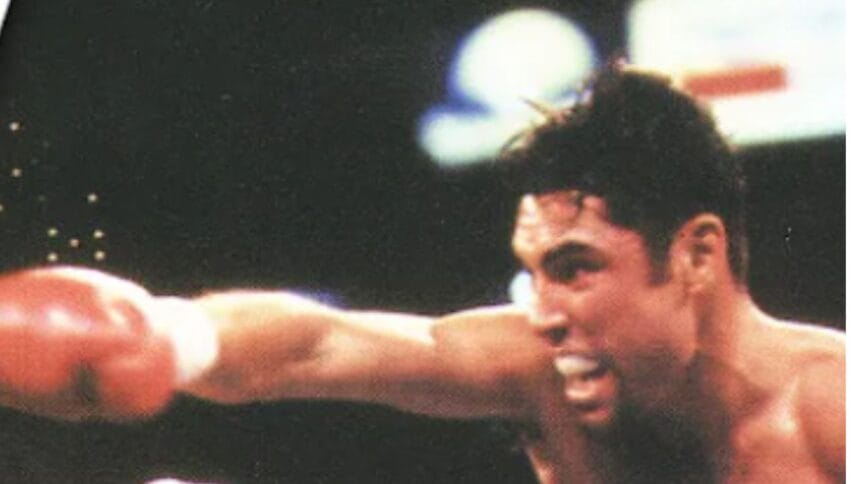
World Boxing News takes a deep dive into the illustrious and often debated career of Oscar De La Hoya, spanning two dynamic decades from 1989 to 2009.
From Humble Beginnings to the National Stage
Oscar De La Hoya, born in Montebello, California, in 1973, emerged from a family steeped in boxing tradition. His grandfather and father were both fighters, setting the stage for Oscar’s journey in the sport. Starting young, De La Hoya amassed over 200 amateur fights, losing just a few before clinching the 1989 National Golden Gloves Bantamweight Title.
The Road to Olympic Glory
By 1991, De La Hoya was the US Amateur Boxer of the Year. His crowning achievement as an amateur came in 1992 when he won the Gold medal at the Barcelona Olympics, earning the moniker “The Golden Boy.” This triumph catapulted him into the national spotlight and set the stage for his professional career.
Explosive Professional Debut
De La Hoya wasted no time transitioning to the professional ranks. Just two months after the Olympics, he knocked out Lamar Williams in a mere one minute and forty-two seconds. His next eleven bouts saw ten knockouts, highlighting his devastating power. In his twelfth fight, De La Hoya dropped down to super-featherweight to challenge Jimmy Bredahl for the WBO title. On March 5, 1994, De La Hoya secured a technical knockout in the tenth round, capturing his first world title at just 21 years old.
First Las Vegas Showdown
De La Hoya defended his title only once before making his Las Vegas debut. On the undercard of a Roy Jones Jr. title defense, he quickly dispatched Giorgio Campanella. Moving up in weight, De La Hoya faced Jorge Paez for the WBO lightweight title, winning by a second-round KO. He then defended this title with two more knockouts before outpointing John Molina at the MGM Grand, showcasing his versatility and skill.
Unification and Dominance at Lightweight
The unification bout against IBF lightweight champion Rafael Ruelas was a pivotal moment. Ruelas, with 43 wins from 44 fights, was seen as a formidable opponent. However, De La Hoya’s prowess was undeniable as he knocked out Ruelas in two rounds, securing his third world title in only his 18th professional fight.
The Emergence of a Superstar
By this time, De La Hoya had captured the hearts of American boxing fans. His combination of skill, power, and charisma made him a household name. The young boxer with the million-dollar smile was now a global superstar.
The Chavez Rivalry: A Battle of Generations
One of the most memorable chapters in De La Hoya’s career was his rivalry with Julio Cesar Chavez. Facing Chavez at Caesars Palace in April 1996, De La Hoya wore the Mexican flag on his shorts. Despite being booed by the predominantly Mexican crowd due to his American Olympic Gold, De La Hoya delivered a masterclass. He overwhelmed Chavez, who was considered past his prime, with speed and power, forcing a stoppage in the fourth round to claim the WBC light-welterweight title.
Endurance and Strategy Against Gonzalez
Miguel Angel Gonzalez, an unbeaten challenger with 41 wins, posed a significant threat. De La Hoya, adding muscle with each weight class he climbed, faced Gonzalez in a tough bout. Though Gonzalez took him the distance, De La Hoya secured a decisive points victory, further solidifying his dominance.
A Controversial Career: Champion or Critic’s Delight?
Throughout his career, De La Hoya faced criticism and controversy. Some argued that his victories against aging legends like Chavez tainted his legacy, while others praised his skill and determination. His ability to move up in weight and continue winning titles, coupled with his marketability, kept him in the spotlight.
Legacy Beyond the Ring
Despite the debates, De La Hoya’s impact on boxing is undeniable. His career not only brought excitement to the sport but also inspired a new generation of boxers. His promotional skills post-retirement further cemented his influence in the world of boxing.
Oscar De La Hoya’s career from 1989 to 2009 remains a topic of passionate debate. Whether viewed as a controversial champion or an undisputed legend, his contributions to boxing continue to be celebrated and scrutinized.